
An idiomatic C# binding for Box3D, the 3D physics engine by Erin Catto, with no managed allocations on the simulation hot path.





Getting started · Guides · Examples · Gallery · Benchmarks · API reference
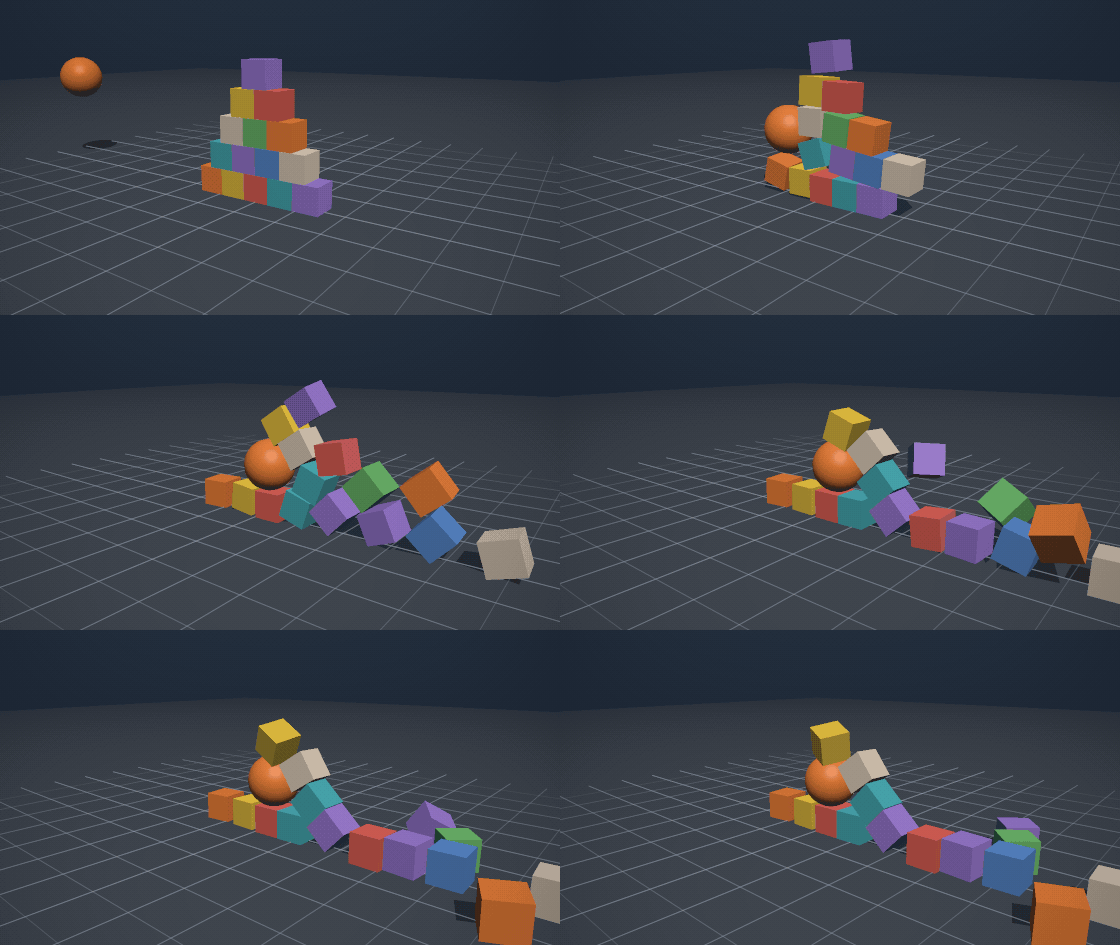
Status: 0.x. Published and usable. The binding is complete and verified against the C ABI, and the idiomatic layer covers worlds, bodies, shapes, queries, events, all nine joint types, meshes, height fields, baked compounds, the character mover and debug draw. The API may still change between minor versions; every break is recorded in the changelog, and packages are validated against the previous release so none happens by accident.
Built with AI assistance. Parts of this project — code, tests and documentation — were written with the help of AI tools. Everything published has been reviewed, and the verification described under Platforms is how the claims here are held to evidence rather than to anyone's word, mine or a model's. See AI assistance.
dotnet add package Box3D.NETusing var world = new PhysicsWorld();
Body ground = world.CreateStaticBody(new Vector3(0.0f, -0.5f, 0.0f));
ground.AddBox(new Box(new Vector3(50.0f, 0.5f, 50.0f)));
Body ball = world.CreateDynamicBody(new Vector3(0.0f, 10.0f, 0.0f));
ball.AddSphere(new Sphere(0.5f));
for (int frame = 0; frame < 120; frame++)
{
world.Step(1.0f / 60.0f);
}
Console.WriteLine(ball.Position); // resting on the groundThat is the whole API for a first simulation: a world, some bodies, shapes on them, and a step. Everything else is opt-in.
// Tune the world when the defaults are not what you want.
using var world = new PhysicsWorld(WorldSettings.Default with
{
    Gravity = new Vector3(0.0f, -9.81f, 0.0f),
    WorkerCount = 4,
});

// Link physics objects to your own game state with an entity id or an index.
ball.UserData = entityId;

// Push transforms into your game from one contiguous array of what moved.
world.Step(1.0f / 60.0f);

foreach (BodyMoveEvent moved in world.Events.BodyMoves)
{
    ref Transform t = ref transforms[moved.Body.UserData];
    t.Position = moved.Position;
    t.Rotation = moved.Rotation;
}

// Shoot something.
RaycastHit hit = world.RaycastClosest(muzzle, aim * 100.0f);
if (hit.Hit)
{
    Damage(hit.Shape.Body.UserData, hit.Point, hit.Normal);
}

// Hang a door on a hinge that stops at ninety degrees.
world.CreateRevoluteJoint(
    RevoluteJointDefinition.Hinge(frame, door, hingePoint, Vector3.UnitY) with
    {
        LimitsEnabled = true,
        LowerAngle = 0.0f,
        UpperAngle = MathF.PI * 0.5f,
});- An API that reads like modern .NET, not like a C header.
- No allocations on the simulation hot path, no boxing, no reflection.
- .NET 8 or later, on Windows, Linux and macOS, x64 and arm64.
- Works under NativeAOT and trimming.
- No dependencies beyond the base class library.
| Package | What it is |
|---|---|
Box3D.NET |
The idiomatic surface. This is what you want. |
Box3D.NET.Native |
The raw P/Invoke layer, a one-to-one mirror of the C API. Reach for it when you need something the high-level API does not expose yet. |
Both are MIT licensed and ship the native Box3D binary for every supported
platform, so dotnet add package Box3D.NET is all that is required.
The decisions below are the ones that shaped the API. Each is also recorded in the commit that introduced it.
b3Vec3 and System.Numerics.Vector3 have the same layout, as do b3Quat and
Quaternion — both are x, y, z followed by a scalar. Using the framework
types directly means no conversion at the boundary with a renderer or engine,
and the vector math gets the BCL's SIMD paths for free. LayoutTests asserts
the assumption rather than trusting it.
PhysicsWorld owns native memory. Body, Shape and the definition types are
handles and values that die with their world, so making them IDisposable would
imply an ownership they do not have.
PhysicsWorld has no finalizer, which is a deliberate departure from the usual
guidance. A finalizer runs on the GC thread at a time of the runtime's choosing,
and destroying a world while another thread is inside Step corrupts the
simulation rather than merely leaking. Forgetting to dispose leaks a world until
the process exits — visible, diagnosable, and much better than a use-after-free
that only shows up under load.
Box3D identifiers are small structs holding an index and a generation counter,
not pointers. Wrapping each one in a SafeHandle would put a finalizable heap
object behind every body in the simulation, which is not worth paying for
thousands of times.
What a SafeHandle would have bought is that a dead handle cannot be
dereferenced, and that has to be bought some other way. Box3D resolves an id by
indexing into the world's arrays and asserting on the way past that the id is
live — and those assertions are compiled out of the release binary this package
ships. Measured on win-x64 against the shipped build, before 0.3.0:
default(Body).Position                 access violation, 0xC0000005
body.Position after body.Destroy()     access violation
body.Position after world.Dispose()    access violation
body.Destroy() twice                   access violation
handle whose index had been reused     returned the replacement body's
                                       position, in silence
The last one is the worst: no crash, no exception, just another body's state reported as yours.
So every member of Body, Shape, Joint and the nine specific joint handles
asks b3Body_IsValid, b3Shape_IsValid or b3Joint_IsValid before it
dereferences, and throws InvalidOperationException if the answer is no. The
check costs 2.07 ns against the 2.66 ns of the b3Body_GetPosition it guards.
IsValid, handle conversions such as hinge.AsJoint, equality and ToString
never throw, so asking is always safe:
foreach (ContactEndEvent touch in world.Events.ContactEnds)
{
    // An end-touch event is often raised *because* a shape was destroyed.
    if (touch.ShapeA.IsValid)
    {
        Handle(touch.ShapeA);
    }
}
One case remains and belongs to Box3D rather than to this binding. A b3BodyId
records which world slot it came from but not that world's generation, so a
handle held past world.Dispose() becomes indistinguishable from a handle into
whatever world next occupies the slot. Nothing in the id can separate them.
HandleSafetyTests pins that behaviour so it is a known boundary rather than a
surprise, and the rule that avoids it is simple: handles do not outlive their
world.
Box3D.NET.Native and Box3D.Interop validate nothing, by design. They are the
C API, and the C API's contract is that a handle is valid.
struct NearestExcludingSelf : IRaycastCallback
{
    public Body Self;
    public RaycastHit Nearest;

    public RaycastAction OnHit(in RaycastHit hit)
    {
        if (hit.Shape.Body == Self)
        {
            return RaycastAction.Ignore;
        }

        Nearest = hit;
        return RaycastAction.ClipTo(hit.Fraction);
    }
}

var callback = new NearestExcludingSelf { Self = player };
world.Raycast(muzzle, aim * 100.0f, ref callback);
The query is generic over the callback type, so the JIT specializes it and devirtualizes the call: your code is inlined into the dispatcher with no delegate allocation, no boxing, and nothing to keep alive across the native transition. A delegate-based API would allocate a closure on every cast.
For the common case there is world.RaycastClosest(...), which needs no
callback at all.
RevoluteJoint hinge = world.CreateRevoluteJoint(
    RevoluteJointDefinition.Hinge(frame, door, hingePoint, Vector3.UnitY) with
    {
        LimitsEnabled = true,
        LowerAngle = 0.0f,
        UpperAngle = MathF.PI * 0.5f,
    });

hinge.MotorEnabled = true;
hinge.MotorSpeed = -1.0f;      // a door closer
hinge.MaxMotorTorque = 50.0f;
CreateRevoluteJoint returns a RevoluteJoint, not a generic Joint. A single
CreateJoint would hand back something that has to be narrowed before it is
useful, and would let a distance joint definition produce a handle whose
revolute members compile and then assert at run time. The shared members are
always one hop away through hinge.AsJoint.
The factory methods matter more than they look. A joint needs a pair of local
frames that describe the same world pose from each body's point of view; get
that wrong and the joint starts out violated and snaps on the first step.
RevoluteJointDefinition.Hinge and Joint.FramesFromWorldAnchor do that
calculation from a world-space anchor and axis.
Box3D.NET never names a Box3D.NET.Native type in public API. If it did,
every consumer touching a handle would take a compile-time dependency on the C
ABI, and the two packages could no longer version independently.
Going down a level is still supported, because a thin wrapper should not be a ceiling — Box3D exports around 580 functions and the idiomatic surface does not cover all of them:
using Box3D.Interop;

b3BodyId raw = body.ToNativeId();
B3.b3Body_SetName(raw, name);
Importing that namespace is the point: the coupling is visible in your source
rather than being the path of least resistance. LayeringTests enforces the
rule over the built assembly by reflection, because a rule like this decays
quietly — one convenient property and nothing fails.
Most geometry is a value: attaching a sphere or a box copies it and there is nothing to manage. Three kinds are not, and the difference is load-bearing:
| Copied on attach? | Disposable | |
|---|---|---|
Sphere, Capsule, Box |
Yes, by value | No |
ConvexHull |
Yes, interned in the world | Yes, freely |
CollisionMesh |
No, borrowed | After the world |
HeightField |
No, borrowed | After the world |
CompoundGeometry |
No, borrowed | After the world |
using var terrain = HeightField.FromHeights(heights, 256, 256, scale);

using (var world = new PhysicsWorld())
{
    world.CreateStaticBody().AddHeightField(terrain);
    Simulate(world);
}
// World first, terrain second. A shape holds a borrowed pointer into it.
Like PhysicsWorld, none of these has a finalizer. Freeing a mesh that a live
shape still points at is a use-after-free inside the solver, and a finalizer
runs whenever the runtime chooses. Leaking until exit is a bug you can see.
var gather = new GatherPlanes { Planes = buffer };
world.CollideCapsule(capsule, position, ref gather);

Span<CollisionPlane> planes = buffer.AsSpan(0, gather.Count);

PlaneSolverResult result = CharacterMover.SolvePlanes(velocity * dt, planes);
position += result.Translation;
velocity = CharacterMover.ClipVelocity(velocity, planes);
That is the whole engine-side problem: find the planes, satisfy them, clip the velocity. What counts as ground, how high a jump goes, whether a slope is climbable — that is game design, and every game answers it differently. Wrapping an opinion about it here would be inventing policy Box3D deliberately left to the caller.
CharacterControllerSample builds a complete controller on these three calls in
about eighty lines, with gravity, jumping, ground detection, slope limits and
wall sliding. Copy it and change the parts that are yours.
Box3D validates its inputs with assertions, and assertions are compiled out of the release builds this package ships. So a NaN is accepted in silence — and it does not stay where you put it.
Measured: setting one body's velocity to NaN and stepping thirty times left a
second body, twenty metres away and never touched, reading (NaN, NaN, NaN).
The solver couples bodies through islands and the broad phase, so one bad number
reaches everything, and there is no way to remove it from a world afterwards.
So the library rejects non-finite values at the call that produced them:
body.LinearVelocity = new Vector3(float.NaN, 0, 0);
// ArgumentException, and the world is untouched
The check costs 0.11 ns, measured against the same native call without it. That is under two percent of a property write, for the difference between an exception with a stack trace and a simulation that silently becomes garbage.
body.UserData is a ulong. The alternative, pinning a managed object with a
GCHandle, reads better in object-oriented code and loses on every other axis:
the handle must be freed when the body is destroyed, a body can be destroyed by
destroying its world, so the world would have to track every handle it issued —
and a missed one is a leak the GC cannot see.
An integer costs nothing, cannot leak, and is what engines actually want back out of a contact event: an entity id or an array index. Shapes carry their own, separate from the body's, which is what lets a hit be attributed to the head rather than merely to the character.
The native assembly is compiled with DisableRuntimeMarshalling. Every P/Invoke
is then a direct call with arguments passed as they already sit in memory, and
any accidentally non-blittable type becomes a compile error instead of a silent
field-by-field copy. Booleans cross the boundary as NativeBool, a one-byte
value type matching C's _Bool.
Box3D's BOX3D_DOUBLE_PRECISION ("large world") mode changes the ABI rather
than being a runtime switch. This binding targets the default single-precision
build, and asserts at test time that the loaded library agrees. Large-world
support, if it lands, will be a separate package.
tools/generate-bindings.ps1 produces the 543 P/Invoke declarations from the
Box3D headers, converting the Doxygen comments into XML documentation along the
way. A mistyped parameter in a hand-written binding does not fail to compile; it
corrupts the stack at run time. Generating removes that class of bug and reduces
a Box3D upgrade to re-running the script and reading the diff. CI fails if the
checked-in output does not match what the script produces.
A C type the script has not been taught is a hard error rather than something
passed through, and BindingSource.Commit records which Box3D revision the
declarations came from, so an assembly can be traced back to its headers.
The declarations are generated, but the structs they pass are hand-written mirrors, and nothing about C# forces a mirror to match. A field of the wrong width, or two fields swapped, compiles and runs: the call succeeds and reads the wrong bytes, so a body ends up with its restitution in the friction slot. There is no crash to investigate.
tools/dump-abi.ps1 compiles a program against the real Box3D headers that
prints sizeof, _Alignof and offsetof for every field, and records the
answers in abi/native-layout.json. The test suite
holds all 92 structs to that file — size, every field offset, blittability, and
whether a mirror exists at all — and CI regenerates it, so a submodule bump that
moves a field fails the build instead of shipping.
Sixteen of them, each headless, self-checking and small enough to read in one sitting. They assert on their own results rather than only printing, so CI runs them — published with NativeAOT — and a regression fails the build instead of producing plausible output nobody reads.
dotnet run --project src/Box3D.NET.Samples -- --list      # what there is
dotnet run --project src/Box3D.NET.Samples -- raycast     # run one
dotnet run --project src/Box3D.NET.Samples                # run all of them
basic-world |
A world, a body, a shape, a step. |
dynamic-body |
Gravity acting on a falling body. |
collision |
A falling box landing on static ground. |
raycast |
Closest-hit and callback ray casts. |
contact-events |
Reading contacts after a step. |
sensor |
A trigger volume that reports overlaps without colliding. |
compound |
One body carrying several shapes. |
continuous |
A fast body that would otherwise tunnel through a wall. |
height-field |
Terrain from a height map. |
mesh |
Collision against a triangle mesh. |
character |
A kinematic character walking, sliding and climbing. |
entities |
Associating game objects with bodies through user data. |
debug-draw |
Feeding the world's debug geometry to a renderer. |
hinged-door |
A revolute joint with limits. |
chain |
A hanging chain of revolute joints. |
vehicle |
A wheeled vehicle built from wheel joints. |
The library is renderer-agnostic, which makes "does the drawing interface
actually work" a fair question. src/Box3D.NET.Visualizer answers it: a console
application with a software rasterizer and its own PNG and GIF writers, no
dependencies beyond the base class library, consuming Box3D.NET through
IDebugDrawer and IDebugShapeFactory and nothing else.
dotnet run --project src/Box3D.NET.Visualizer -- --list # what there is
dotnet run --project src/Box3D.NET.Visualizer # render all of them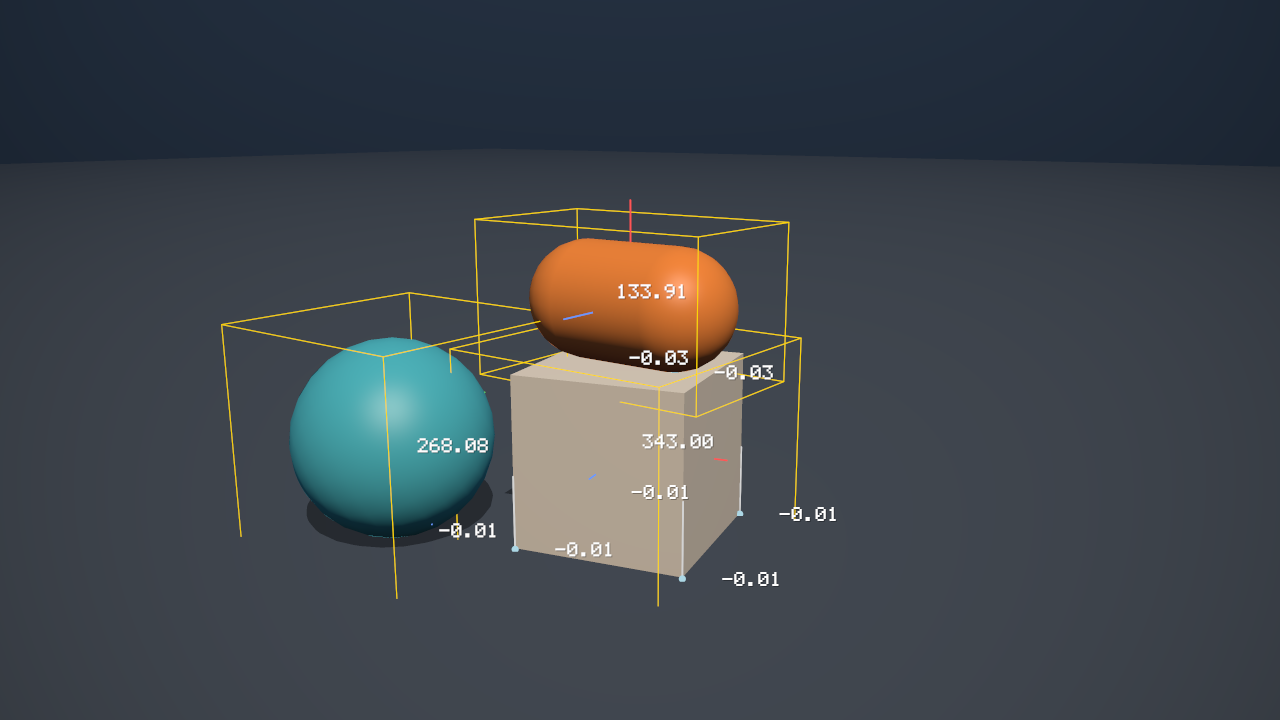 contacts — what the solver is working with |
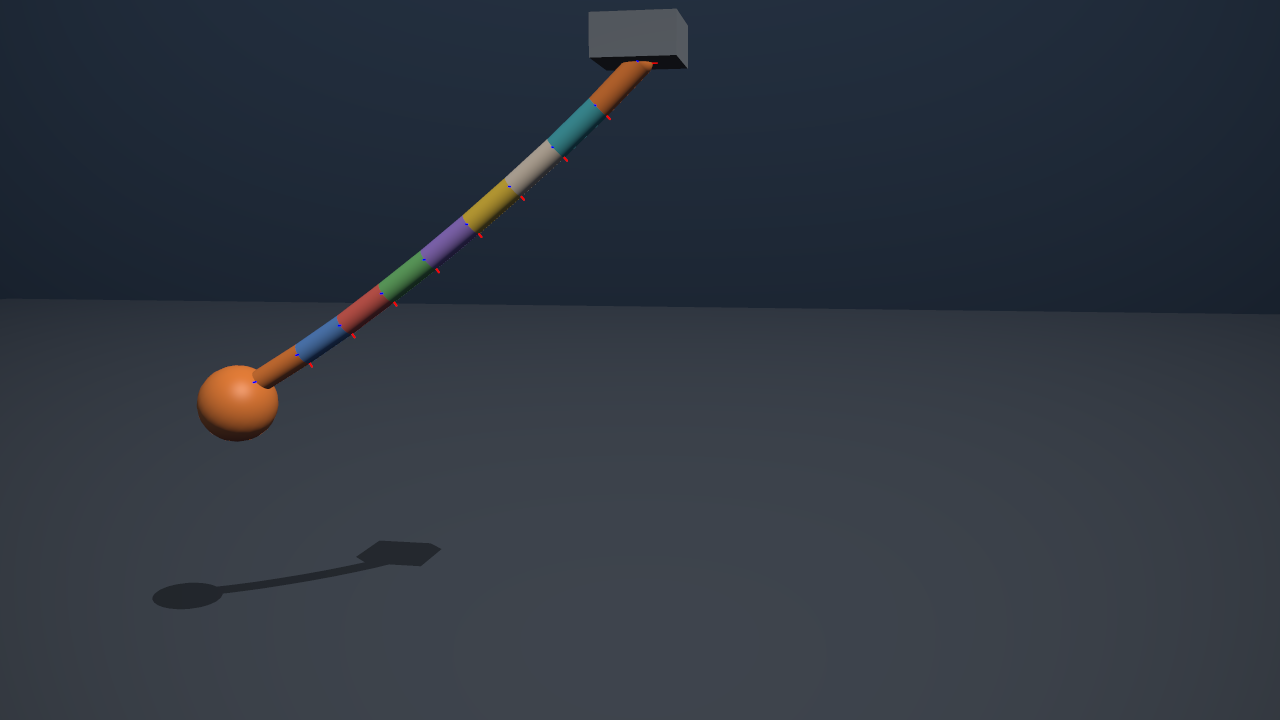 chain — nine hinges and a weight |
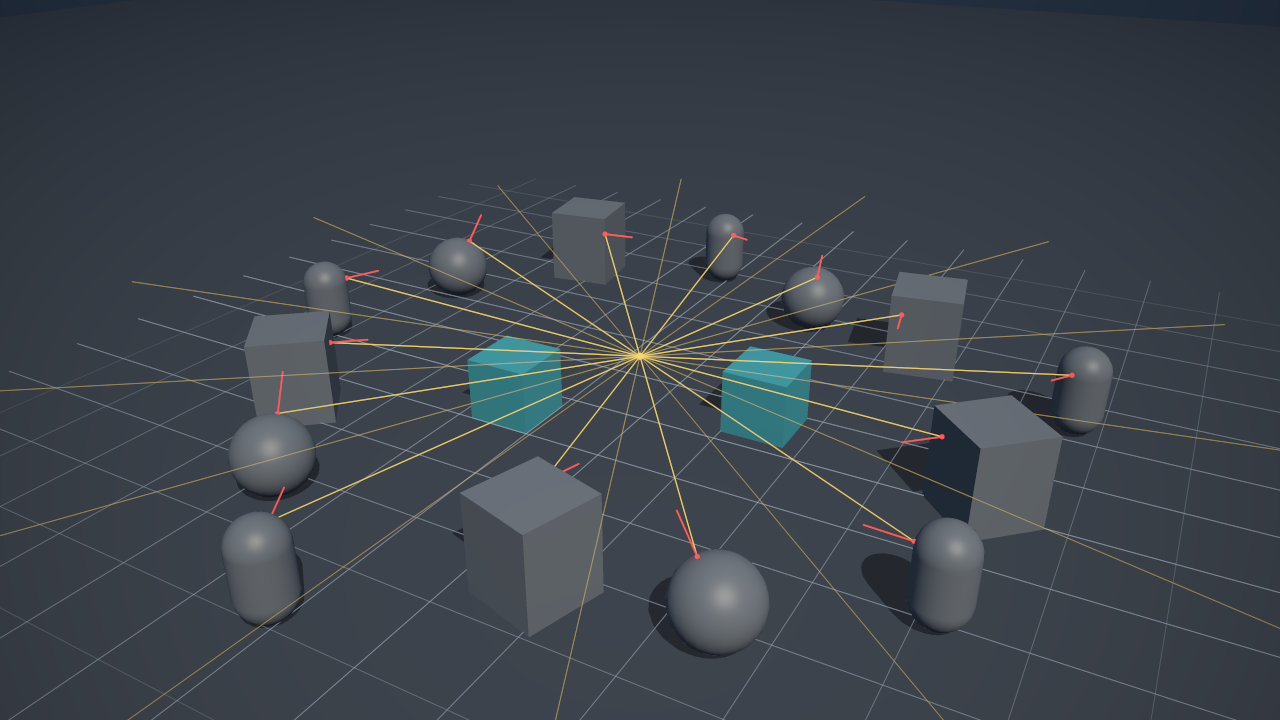 raycast — closest hit and normal, per ray |
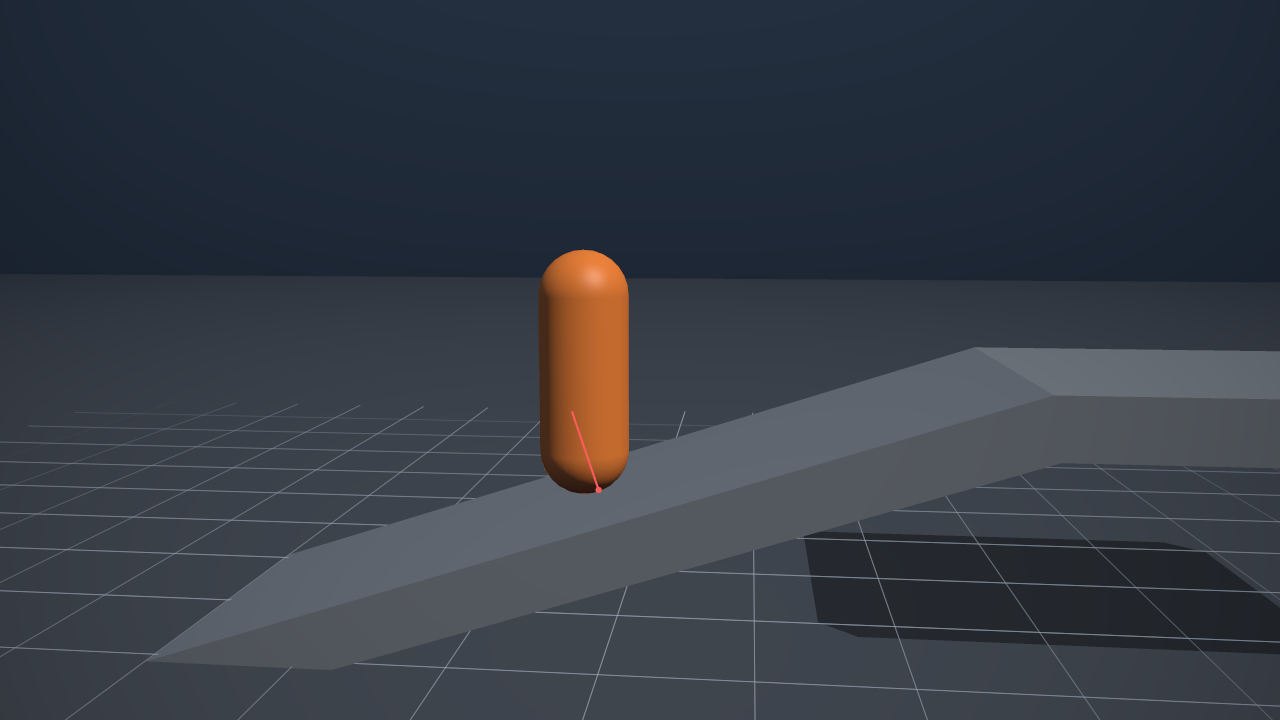 character — the mover primitives |
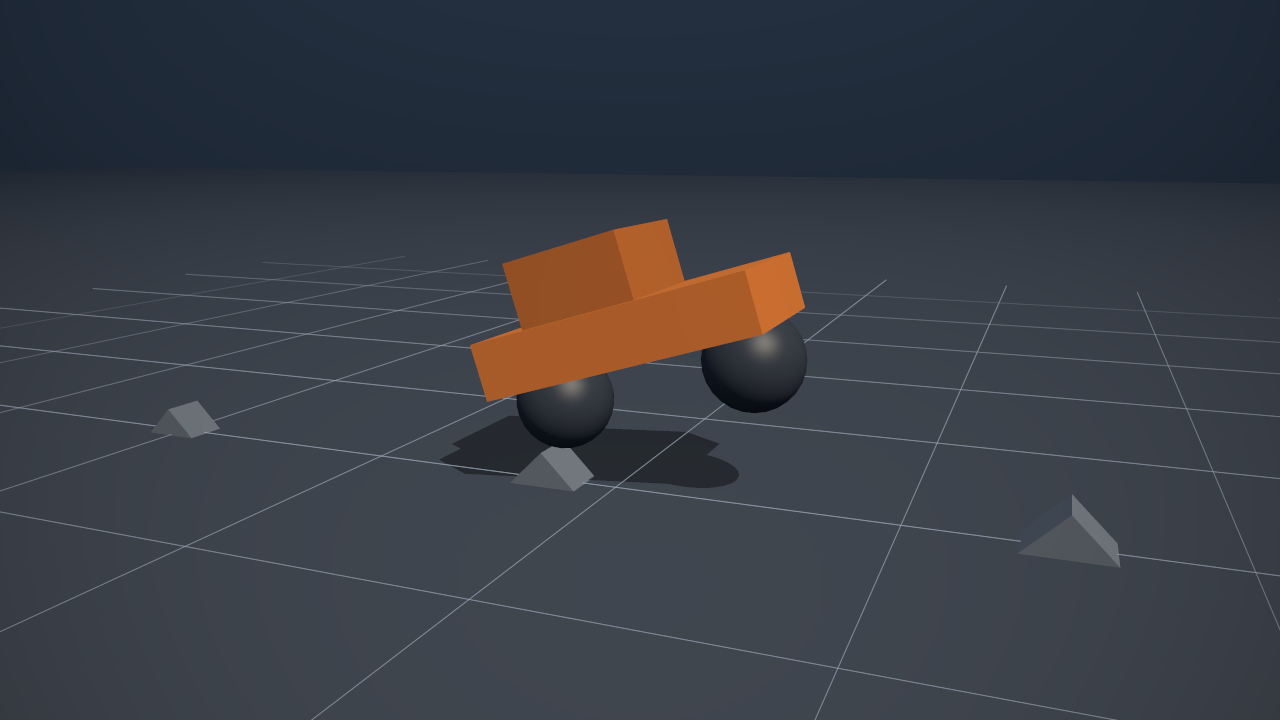 vehicle — suspension, a motor, a mesh ramp |
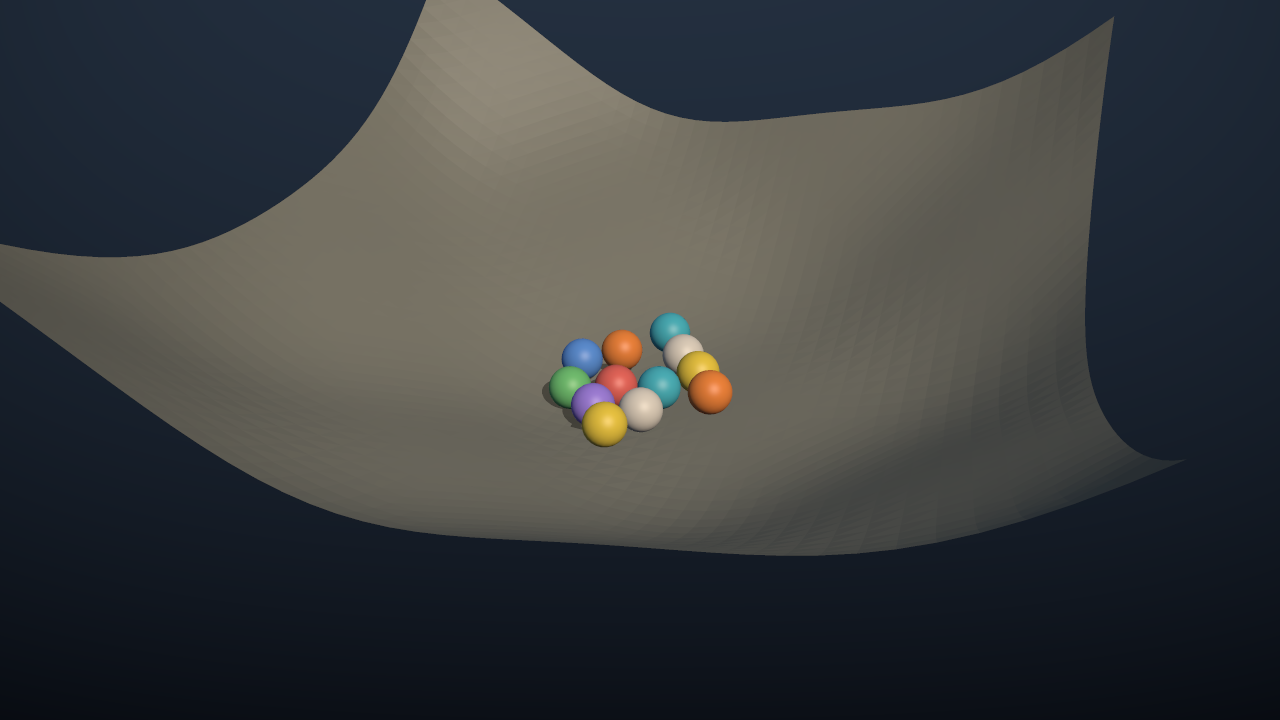 terrain — a height field, read back from the engine |
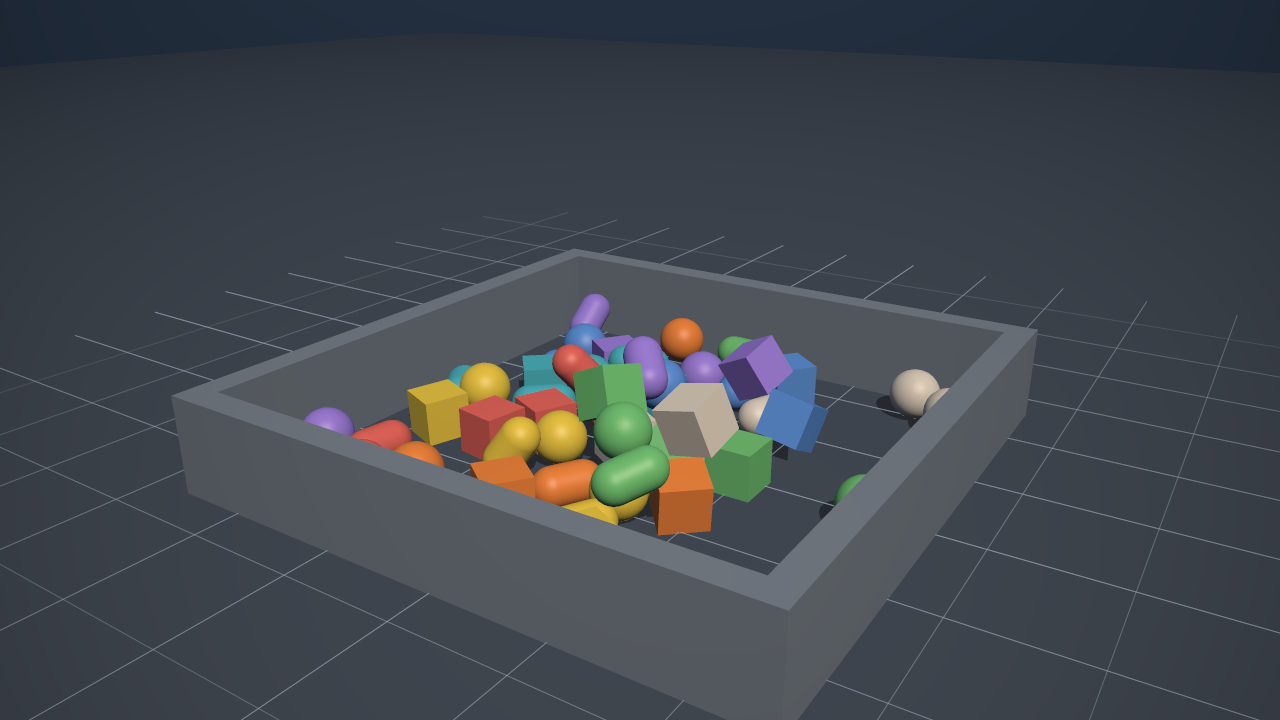 pour — fifty-four bodies, three shapes |
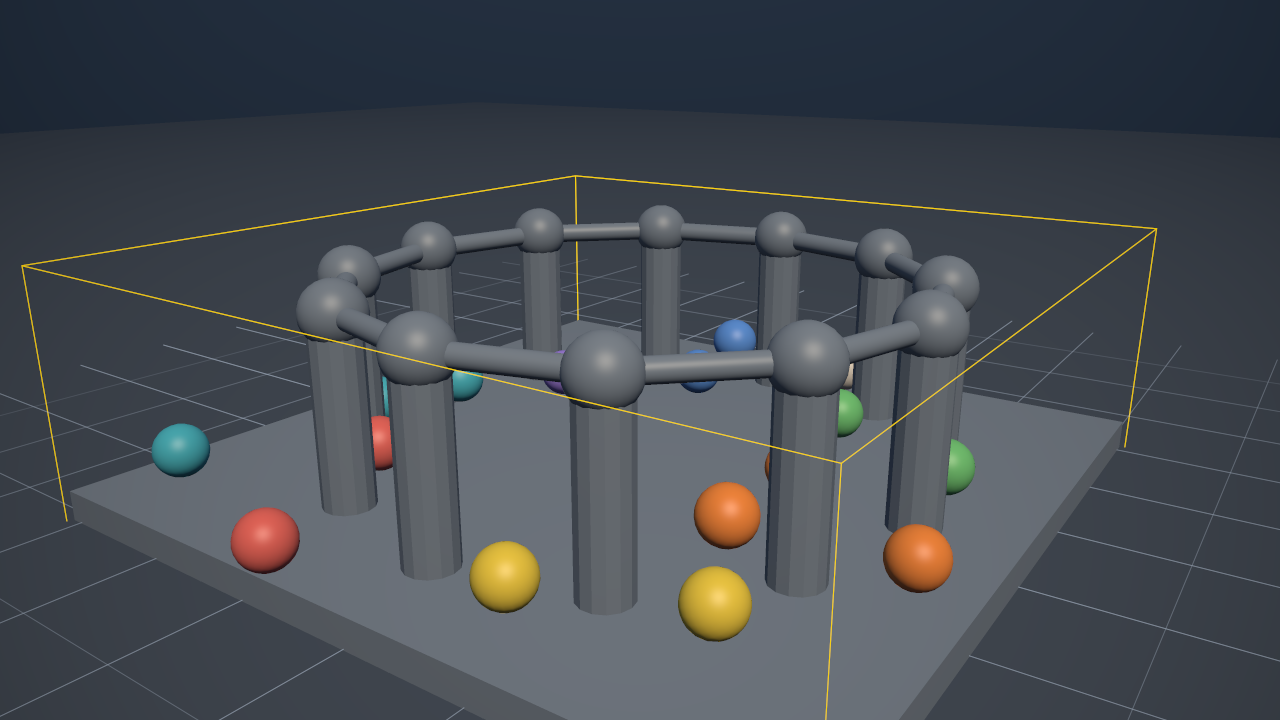 compound — thirty-seven children, one proxy |
All nine, animated, are in the gallery.
| Getting started | Install, first simulation, the loop. |
| Guides | Bodies, shapes, filtering, queries, events, joints, terrain, characters, debug draw. |
| Concepts | The step, memory and ownership, handle validity, threading, the native layer. |
| Examples | Sixteen runnable samples, and what each one teaches. |
| Gallery | Nine scenes, animated, drawn through the public debug draw interface. |
| Benchmarks | What the wrapper costs, measured. |
| Architecture | How the binding is generated and held to the C API. |
| API coverage | Every function Box3D exports, how it is bound, and whether the idiomatic layer reaches it. |
| API reference | Every public type, generated from the XML documentation. |
The reference site is rebuilt from source on every push, so it cannot drift from the code. Build it locally with:
dotnet tool restore
dotnet docfx docs/docfx.json --serveRequires the .NET 8 SDK or later, CMake 3.22 or later, and a C compiler.
git clone --recursive https://github.com/Miguel249/Box3D.NET
cd Box3D.NET

# Build the native library for this machine.
pwsh tools/build-native.ps1

dotnet build
dotnet test
Box3D lives in external/box3d as a submodule pinned to a specific commit. It
is never modified; this project only consumes it.
Without the native library the project still builds, and the layout and math
tests still run. The tests that call into Box3D skip themselves rather than
fail, so dotnet test is useful immediately after cloning. CI always stages a
binary and then fails if anything was skipped.
Building the repository needs nothing beyond the .NET 8 SDK. The iOS target framework is off unless asked for, because it needs the .NET 10 SDK and a workload that does not exist for Linux at all:
dotnet pack -c Release -p:Box3DTargetApple=true # needs .NET 10 and the ios workloadThat is what the packaging job runs, on a runner that can. Everything else —
building, testing, formatting — is net8.0 as it has always been.
build-native.ps1 takes the platform from the runtime identifier, so the same
script cross-compiles:
pwsh tools/build-native.ps1 -Rid android-arm64   # needs the Android NDK
pwsh tools/build-native.ps1 -Rid android-x64

# macOS only, and all three are needed before the framework can be assembled.
pwsh tools/build-native.ps1 -Rid ios-arm64
pwsh tools/build-native.ps1 -Rid iossimulator-arm64
pwsh tools/build-native.ps1 -Rid iossimulator-x64
pwsh tools/create-xcframework.ps1
The Android build finds the NDK through ANDROID_NDK_HOME or the Android SDK,
and will borrow the CMake and Ninja bundled with the SDK if neither is on PATH.
iOS needs Xcode and therefore a Mac; a package packed anywhere else simply has
no iOS binaries in it, and says so at the consumer's build rather than at their
run time.
| Suite | What it protects |
|---|---|
AbiTests |
All 92 structs against what the C compiler reports for the same declarations: size, every field offset, blittability, and whether a mirror exists at all. |
LayoutTests |
A core set of sizes against values derived by hand from the C declarations. Narrower than AbiTests and kept because it needs neither a native binary nor a C toolchain. |
DebugDrawTests |
That debug draw reaches a managed drawer with usable values, that a shape factory is asked once per shape rather than once per frame, that disposal releases every drawable, and that a drawn frame allocates nothing. |
MathTests |
The math ported from the B3_INLINE functions, by algebraic identity and by agreement with System.Numerics. |
NativeInteropTests |
The binding against the real library: default definitions come back intact, bodies fall, rays hit, and b3GetByteCount returns to its starting value after worlds and hulls are destroyed. |
JointTests |
Joint behaviour, not round trips: limits actually hold, motors actually lift, filter joints actually let bodies through. |
LayeringTests |
That no Box3D.NET.Native type reaches the public surface, checked by reflection over the built assembly. |
UserDataTests |
Identifiers survive the round trip through the native void*, including the top bit, and come back from events and queries. |
GeometryTests |
Hull, mesh and height field behaviour, and the ownership rules for each. |
CharacterMoverTests |
Contact gathering, the plane solver, velocity clipping, and a character sliding along a wall. |
FuzzTests |
Non-finite input, extreme magnitudes, degenerate geometry, and seeded random operation sequences. |
DeterminismTests |
That the same scene run twice hashes identically, bit for bit, including alongside other worlds and interleaved queries. |
ThreadingTests |
That independent worlds step in parallel and reach exactly the state they would have reached alone. |
StressTests |
A thousand bodies, sixty-link chains, the world limit, and leak checks over every create-and-destroy cycle. |
HandleSafetyTests |
That a destroyed, default or orphaned handle throws instead of reading freed memory, in every way one can be produced, and that a disposed world's every member throws. |
GeometryOwnershipTests |
One mesh behind many shapes, every safe teardown order, and ten thousand build-and-release cycles per geometry kind with the native byte count required to return to zero. |
AllocationTests |
That the documented hot paths allocate exactly zero managed bytes: Step, body and shape access, body creation, both ray cast forms, overlap, every event list, joint access and the character mover. |
Tests that call into Box3D share a non-parallel xUnit collection. The library keeps process-wide state — the allocated byte count, the live world count — so a leak test running beside another class that creates worlds is measuring noise.
The short version: one world, one thread. Everything below is the long version, and each row is what the threading tests actually exercise rather than what would be nice to promise.
| Operation | Safe concurrently? |
|---|---|
Step on different worlds |
Yes |
| Reads and queries on different worlds | Yes |
new PhysicsWorld(...) and Dispose from several threads |
Yes, serialised by this library |
| Anything on one world while that world is stepping | No |
| Two threads mutating one world | No |
| Two threads reading one world, nothing stepping | Yes |
Passing a Body, Shape or Joint between threads |
Yes, the handle is a value |
Reading Events while that world is stepping |
No |
A PhysicsWorld is not internally synchronised, and deliberately so: a lock
around Step would cost every user to protect a pattern the engine does not
support anyway. Give each world an owner, and hand results to other threads
afterwards.
Two things are worth knowing beyond the table.
World creation and destruction are guarded here, not by Box3D. The engine
keeps its worlds in one global table and picks a slot by scanning for a free
entry, then marks it in use some thirty lines later; nothing synchronises the
two. Two threads creating a world at the same time can select the same slot, and
the corrupted world then spins forever inside Step rather than failing. Box3D's
own documentation says to hold a mutex around those calls, so PhysicsWorld
holds one. It covers only the two native calls, so Step, queries and body edits
never touch it. Code calling b3CreateWorld through Box3D.NET.Native directly
is outside that guard and on its own.
A world may already be using several threads. WorkerCount above one lets
Box3D start and own worker threads for the solver. That is internal parallelism
inside one Step on one calling thread; it does not make the world safe to touch
from your own threads, and it is not additive with running several worlds at
once — the cores have to come from somewhere.
Box3D is written for cross-platform determinism, which is what makes lockstep
networking and replay possible. This binding's job is not to undermine it, and
DeterminismTests is what holds it to that: it hashes the exact bits of every
body's position and velocity after a fixed number of steps and requires equality,
not closeness.
What is verified, on every CI platform:
- the same scene run twice, and run many times, gives identical bits;
- other worlds existing alongside it change nothing;
- interleaving two worlds step by step changes neither;
- a query between steps changes nothing;
- reading events changes nothing;
- a multithreaded world is reproducible against itself.
What is not verified here, and so is not claimed: that two different platforms or architectures produce identical bits for the same scene. That is a property of Box3D and of the compiler it was built with, not of this binding, and proving it would mean comparing hashes across the CI matrix rather than within each runner. Until that exists, treat cross-platform determinism as Box3D's claim rather than as this package's.
Determinism also depends on things the caller controls: a fixed time step, a fixed sub-step count, and the same sequence of operations. A variable time step makes a simulation non-reproducible no matter what either layer does.
Measured, not asserted. See docs/benchmarks.md for method and conditions.
A whole frame, both worlds built identically so the only difference is which
Step is called:
| Bodies | C API | Box3D.NET | Ratio | Allocated |
|---|---|---|---|---|
| 100 | 75.29 µs | 75.48 µs | 1.00 | 0 B |
| 1,000 | 746.82 µs | 745.40 µs | 1.00 | 0 B |
| 10,000 | 7,704.64 µs | 7,723.55 µs | 1.00 | 0 B |
The wrapper's overhead on a step is not measurable.
Individual calls, where the wrapper is a larger share of a smaller number:
| Native | Wrapper | Ratio | Allocated | |
|---|---|---|---|---|
| Read a body position | 8.998 ns | 9.496 ns | 1.06 | 0 B |
| Ray cast, closest hit over 200 shapes | 175.4 ns | 171.7 ns | 0.98 | 0 B |
| Ray cast with a struct callback, nearest | — | 168.9 ns | — | 0 B |
| Drain every event list after a step | — | 164.5 ns | — | 0 B |
| Create 1000 bodies with spheres | 725.2 µs | 1,066.4 µs | 1.48 | 0 B |
Everything allocates nothing, including the callback forms, the event
enumeration and a drawn debug frame — AllocationTests requires exactly zero
bytes on each of those paths rather than taking the benchmark's word for it.
Two figures are worth reading properly. Reading a body position now includes the
handle validity check, which is why it moved from parity to 1.06. And creating
bodies in bulk is the one place the wrapper genuinely costs something: it
rebuilds b3BodyDef and b3ShapeDef per body where the C loop hoists them.
That 1.48 replaces a 1.13 recorded for 0.2.0 that does not reproduce here — the
published 0.2.0 package measures 1.54 on this machine, so it is a correction to
the documentation rather than a regression. docs/benchmarks.md
has the full working.
Built and verified in CI on every push. Only what is listed here is claimed.
The package consumer column is the one that matters, and it is not the same
question as "do the tests pass". The tests run against a project reference,
which resolves assemblies out of bin/ and copies the native library through a
build target — it never touches the package's runtimes/<rid>/native layout or
the NuGet asset resolution that a real consumer depends on. So CI also installs
the packed .nupkg into a project that has never heard of this repository, and
runs a scene through it: create a world, create bodies and shapes, step 240
frames, check the ball actually fell and actually stopped, ray cast, read
events, dispose.
| Runtime identifier | Native build | Test suite | Package consumer | Trimmed | NativeAOT |
|---|---|---|---|---|---|
win-x64 |
yes | yes | yes | yes | yes |
win-arm64 |
yes | — | yes | — | — |
linux-x64 |
yes | yes | yes | yes | yes |
linux-arm64 |
yes | — | yes | — | — |
osx-x64 |
yes | — | under Rosetta | — | — |
osx-arm64 |
yes | yes | yes | yes | yes |
android-arm64 |
yes | — | in the apk | — | — |
android-x64 |
yes | — | in the apk | — | — |
ios-arm64 |
yes | — | — | — | — |
iossimulator-arm64 |
yes | — | linked | — | — |
iossimulator-x64 |
yes | — | — | — | — |
A dash is "not verified", not "known broken". Trimming and NativeAOT are checked on the three runners where the toolchain is native rather than cross-compiled; a cross-compilation failure on the others would say more about the runner than about this package, and claiming a platform on that evidence would be worse than leaving the cell empty.
osx-x64 carries its own caveat. GitHub's Intel macOS image is being retired,
and a job asking for one sat queued for over an hour without ever being picked
up, so the x64 package is installed and run on the arm64 image under Rosetta 2
instead. It is published self-contained there, because a framework-dependent x64
binary starts under Rosetta and then fails to load an x64 libhostfxr.dylib
that an arm64 runner does not have — a fact about the runner rather than about
the package.
That still exercises what matters: the x64 native asset is resolved out of the package, the x64 library is loaded, and the simulation runs and is checked. What it does not prove is behaviour on Intel silicon, which is why the cell says what it says rather than "yes".
The mobile rows say something weaker than the desktop ones, on purpose. Every desktop row is backed by a simulation that ran and was checked; no CI runner can start an application on a phone, so those two words are the honest ceiling:
-
in the apk — CI builds a real Android application against the packed
.nupkg, then opens the resulting.apkand confirmslibbox3d.sois inside it forarm64-v8a. That covers the failure mode specific to Android: an unresolved runtime asset produces a perfectly valid application that dies on its first physics call. -
linked — CI builds a real iOS application against the packed
.nupkg, then reads the executable it produced withnmand requires Box3D's own native symbols to be defined in it. That is the failure mode specific to iOS: the library is linked into the application rather than loaded, and a P/Invoke to__Internalis resolved by Mono at run time, so an application the archive never reached builds and launches exactly like a correct one and fails on its first physics call.Only symbols named
_b3…count, since those can only have come out oflibbox3d.a. An AOT-compiled method carries its parameter types in its mangled name, sob3BodyIdandb3ShapeDefturn up inside managed symbols like_Box3D_NET_Box3D_Body__ctor_Box3D_Native_b3BodyId, which are in the binary whether or not the archive survived the link. Those are counted too, separately, because they answer the other question — whether the trimmer kept Box3D's C# at all — and between them they say which half to go and look at when the check fails.A stripped executable would leave nothing to read, and the check falls back to the build log's evidence that the linker was handed the archive, reporting that it did so rather than claiming the stronger result. That has not happened yet: the release simulator build keeps its symbol table.
Neither runs a simulation on a device. If you ship Box3D.NET on a phone, test on a phone.
Two details are worth knowing before you take the dependency:
- Only 64-bit Android.
armeabi-v7ais not shipped. Google Play has required 64-bit for years, and Box3D disables NEON on armv7 — which has no divide or square root — so that ABI would ship a slower scalar build for devices that cannot be published to anyway. - iOS needs
net10.0-ios. Every other platform is served by thenet8.0assembly. iOS gets its own, because Apple does not allow an application to load a dynamic library that is not a signed framework, so Box3D is linked statically and the binding has to name__Internalinstead ofbox3d. That requires a target framework of its own, and .NET 8's and 9's iOS workloads are out of support — the SDK refuses to buildnet8.0-iosat all.
Requires .NET 8 or later, except on iOS, which requires .NET 10 or later.
Issues and pull requests are welcome. What CI will check, so there are no surprises:
dotnet build  -c Release          # warnings are errors, documentation included
dotnet test   -c Release          # every test, on the platform you are on
dotnet format --verify-no-changes --severity warn
Four checks are easy to trip and worth knowing about in advance:
- Public members need XML documentation. It is a build gate, not a warning.
- Regenerate after bumping the submodule.
tools/generate-bindings.ps1andtools/dump-abi.ps1both write files that CI compares against the headers, and a bump without a regenerate fails the build. That is the point of them. - Do not add a benchmark over a settled scene. Box3D skips sleeping bodies,
so it measures nothing. Set
EnableSleep = false, and state what the scene should be doing withWorkload.RequireAwake— a benchmark that stops doing real work now fails rather than quietly getting faster. - Do not allocate on a hot path.
AllocationTestsmeasures the documented ones withGC.GetAllocatedBytesForCurrentThreadand requires exactly zero bytes, so a captured closure or a boxed enumerator fails the build.
CI also installs the packed .nupkg into a fresh project on all six platforms
and runs a simulation through it, which is the only check that exercises the
package rather than the repository. Reproduce it locally with:
dotnet pack --configuration Release --output artifacts/packages
pwsh tools/verify-package.ps1
Changes to the public API are checked against the last published package automatically. A break is allowed before 1.0, but it belongs in the changelog rather than in someone's build log.
The engine is a pinned, unmodified submodule.
git -C external/box3d checkout <commit>
pwsh tools/generate-bindings.ps1     # re-emit the P/Invokes and record the commit
pwsh tools/dump-abi.ps1              # re-record the struct layouts
dotnet test -c Release
Read both diffs. A changed offset in abi/native-layout.json means a struct
moved and its managed mirror has to move with it; the tests will say which.
This project was built with AI assistance. That covers a substantial part of the code, the tests, the tooling and this document, and it is stated here plainly because you deserve to know what you are taking a dependency on.
What that does and does not mean:
- Every published change was reviewed before it shipped. AI wrote a great deal of it; nobody merged anything unread.
- The claims in this README are held to evidence rather than to assertion, which matters more here than it would otherwise. The binding is checked against the real C ABI, struct layouts are recorded and compared, the packages are installed by a project that has never heard of this repository and a simulation is run and its results checked, and the performance numbers come from a benchmark that fails when it stops measuring what it says it measures. A confident sentence is not evidence, whoever wrote it.
- Where something is unverified, the documentation says so instead of rounding up. The dashes in the platform table and the deliberately weaker wording for Android and iOS are examples.
Box3D itself is Erin Catto's work and is redistributed unmodified.
MIT. See LICENSE. Box3D is likewise MIT licensed and is redistributed unmodified as a native binary, with its copyright notice intact.